

Generative artificial intelligence is supporting the automation of processes in many industries. In this article, we will delve into one Generative AI use case that Pragma has developed in the insurance sector.
At the beginning of 2024, we told you how a business group providing services in the fields of policies, social security, and trusts in Central America built an Azure AI and Cognitive Search-based chatbot with Pragma. Six months later, we want to share some of the progress we have made with eight new features and some projects we have for the middle and long term.
Initially, this project sought to create a solution that enabled all the company's collaborators to access data from the company intuitively, efficiently, and accurately. For this reason, we trained an Artificial Intelligence that supported the sales staff by answering queries in natural language. This way, we made the company's portfolio consultation easier while ensuring that collaborators, especially those in the sales teams, consumed accurate and updated information.
Additionally, this first iteration of the project avoided hallucinations, i.e., answers that are not based on actual data, which are a susceptible issue for companies that want to start using AI in their processes.
Eight new functionalities: how our AI-based chatbot has evolved
Our first step was to analyze the success stories of companies that have improved their processes through tools similar to the one we had built.
By doing this benchmark, we realized that we could create sections of our AI that were specialized in specific functions. These are some of the ones we have developed:
- Data query tool
Today, by having access to relational databases, our AI allows us to obtain data-driven insights without the need for advanced technical knowledge through reports and visualizations that facilitate understanding and analysis. - Price estimation wizard
Calculates and presents customized insurance price estimates, considering different variables. - Document reader
Our AI reads and processes documents in PDF or text format to extract relevant information and answer specific questions. As it is not a public AI, we can offer this functionality to guarantee the security of confidential information and allow only the user who uploaded the document to access the results. - Writing assistant
In addition to text, the AI can be trained with images to generate attractive content adapted to social networks. It can also be used to write accurate and concise meeting minutes from notes or recordings. - Information Simplifier
This functionality covers AI's capability to build answers in different formats based on large amounts of information. These formats include lists, tables, flat files, JSON dictionaries, etc. - Programming Assistant
The AI we develop can help developers write code, detect and correct programming errors, and generate database queries. - Transcription tool
This functionality currently works as a demo and is being used to complete forms based on information from PDF documents or audio files that it transcribes and identifies as relevant. - Communication with relational databases
Currently, the tool can communicate with a relational database (SQL Server), query it, bring the answers sought, and even generate graphs based on these answers. This is one more step towards the democratization of information, allowing collaborators to make queries without the need to master the SQL language.
The future: End-user interaction, integrations, and a digital avatar
So far, the artificial intelligence we developed for this insurer has supported the work of the company's employees. The new challenge is to implement it to serve end users.
We have had successful pilots in which the AI has responded accurately and with the right tone of communication to Whatsapp queries. This new functionality requires orchestrating several details, especially everything related to training and data protection, but we expect to have a launch in the short term.
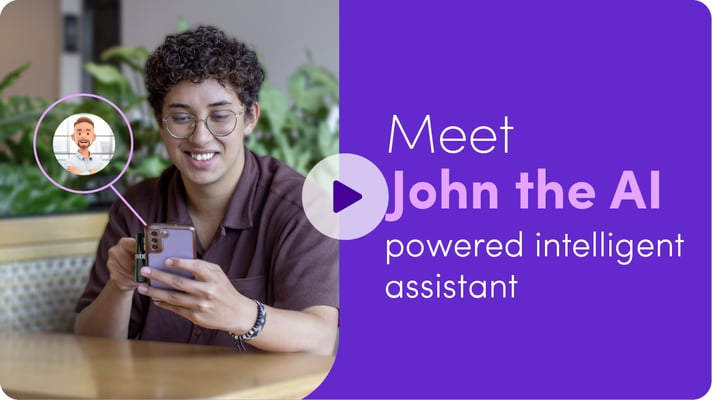
Another area in which we have made very positive progress is creating a meta persona, a character, or an avatar through which users can interact with the AI.
In this field, we have managed to train the voice of artificial intelligence, and thanks to the functionalities we have already built, we have obtained information from audio and generated responses with that information, resulting in a functional version capable of holding conversations.
The next step is to develop the graphic avatar, something we can advance quickly, as there are open-source resources to achieve it. Despite this, the costs related to this new dimension of Artificial Intelligence could make it take a little longer to have an implementation.
Towards an AI-friendly organizational culture
As has been said many times throughout this article, one of the points that we have taken the most care in implementing this Artificial Intelligence tool has been everything related to data protection.
This is a particularly sensitive issue in insurance sector organizations, and that is why we have managed to build a digital solution that, unlike those of public access, allows us to protect and govern the data with which it is fed.
On this basis of trust, we will continue to contribute to building an organizational culture in which there is clarity and transparency regarding the limits that tools of this type may have while promoting the adoption and use of the functionalities in each area of the organization and for the end user.
Do you want to develop solutions based on Artificial Intelligence with the support of an expert partner?

Share this

Data Architecture for Banking: A Guide to Success

Banking in The Era of Artificial Intelligence: A Comprehensive Guide

AI for compliance in banking: Role in fraud risk reduction